
Red, Wild, and Revolutionary: The Case for Bee Balm (Monarda didyma)

Every garden needs a plant with presence — something that does more than fill space or bloom on schedule. A plant that carries energy, history, and consequence. For me, that plant is red bee balm, Monarda didyma.
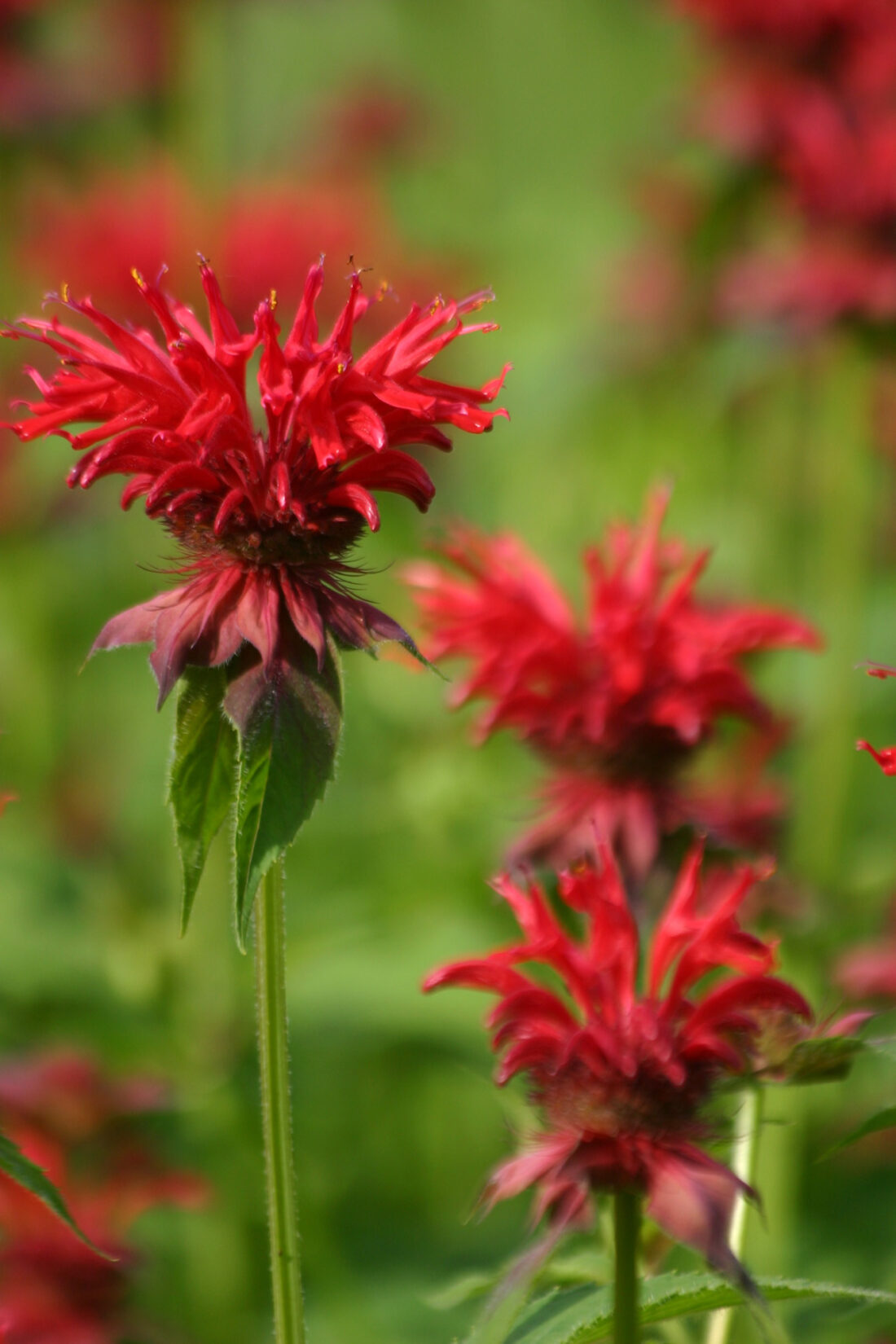
Yes, the lavender and pink forms are lovely. I grow them too. But the red? The red is different. It’s electric. It vibrates with color and motion, alive with bees, hummingbirds, and heat. It doesn’t politely decorate a border — it announces itself.
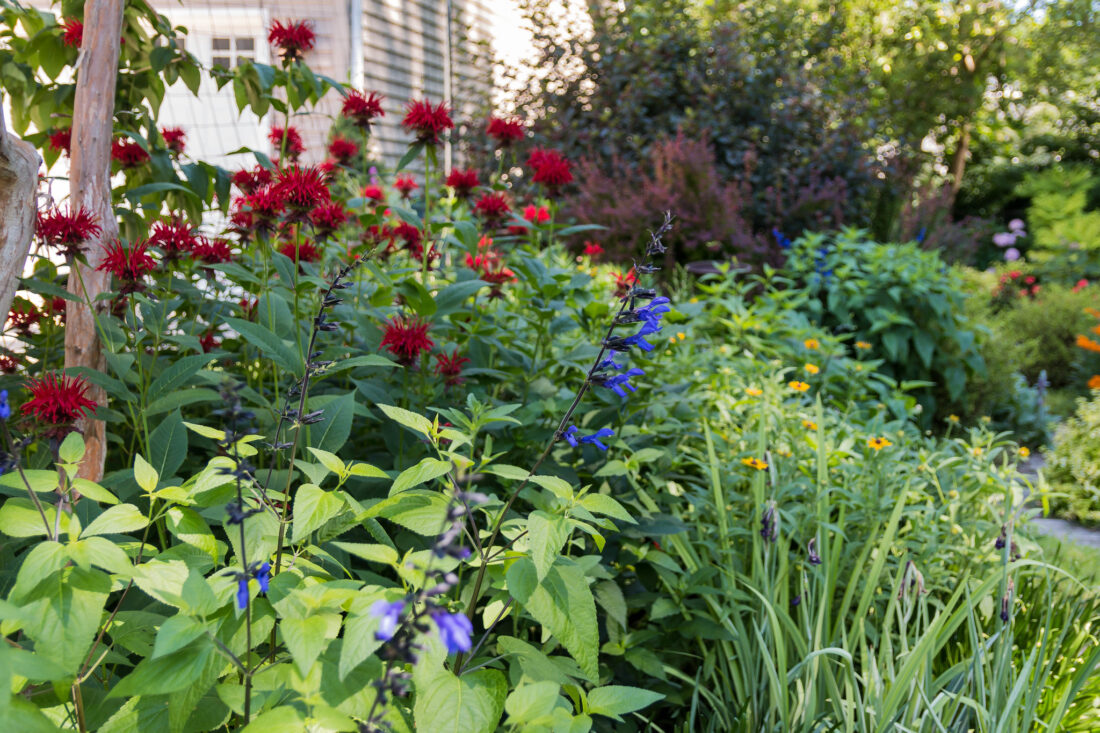
This year, I’m planting a wide swath of red bee balm threaded through lavender, and I already know how it will behave. The contrast alone — cool violet against saturated crimson — is enough to stop you mid-step. Add scent, movement, and pollinators, and the garden becomes less a picture and more an experience.
The deep red of Monarda didyma isn’t a breeding flourish — it’s the original signal. That color evolved for hummingbirds, not aesthetics, and it carries a specific ecological and cultural lineage. Many pink and purple forms are beautiful and useful, but the red holds a tighter connection to place, history, and purpose.
Bee balm doesn’t just decorate a garden — it feeds a food web, stabilizes wet ground, and signals seasonal abundance.
Monarda didyma – A Native with a Story
Monarda didyma is native to much of the eastern United States, thriving in sun and consistently moist soil. When it’s happy, it grows tall — two to four feet — sending up blooms that resemble firecrackers perched on mint-scented stems. Like many members of the mint family, it spreads readily. It wants to be part of a colony, not a lone specimen.
It’s also known as bergamot — not the citrus that gives Earl Grey tea its flavor, but a plant with a long medicinal history. Indigenous communities used bee balm for generations to treat colds, fevers, and headaches. That unmistakable scent isn’t incidental — it’s chemistry doing work. Long before it became a pollinator darling or a design statement, it was a plant of utility and care.
Oswego Tea and Quiet Act of Yankee Defiance
Bee balm carries an unusual piece of American history — one rooted not in conquest, but in substitution.
After the Boston Tea Party in 1773, colonists turned away from imported tea as an act of protest. The Oswego people of present-day upstate New York had already been using Monarda didyma as a brewed tea, and settlers quickly adopted it. “Oswego Tea” spread throughout the colonies — not as a novelty, but as a practical, locally sourced alternative.
It’s a small story, but an instructive one. Plants have always played roles in resistance, adaptation, and cultural survival. Bee balm wasn’t just growing in gardens; it was quietly reinforcing independence.
Design With Intent
From a design perspective, bee balm earns its keep.
It brings height and vertical emphasis to borders.
It thrives in damp sites where other perennials sulk.
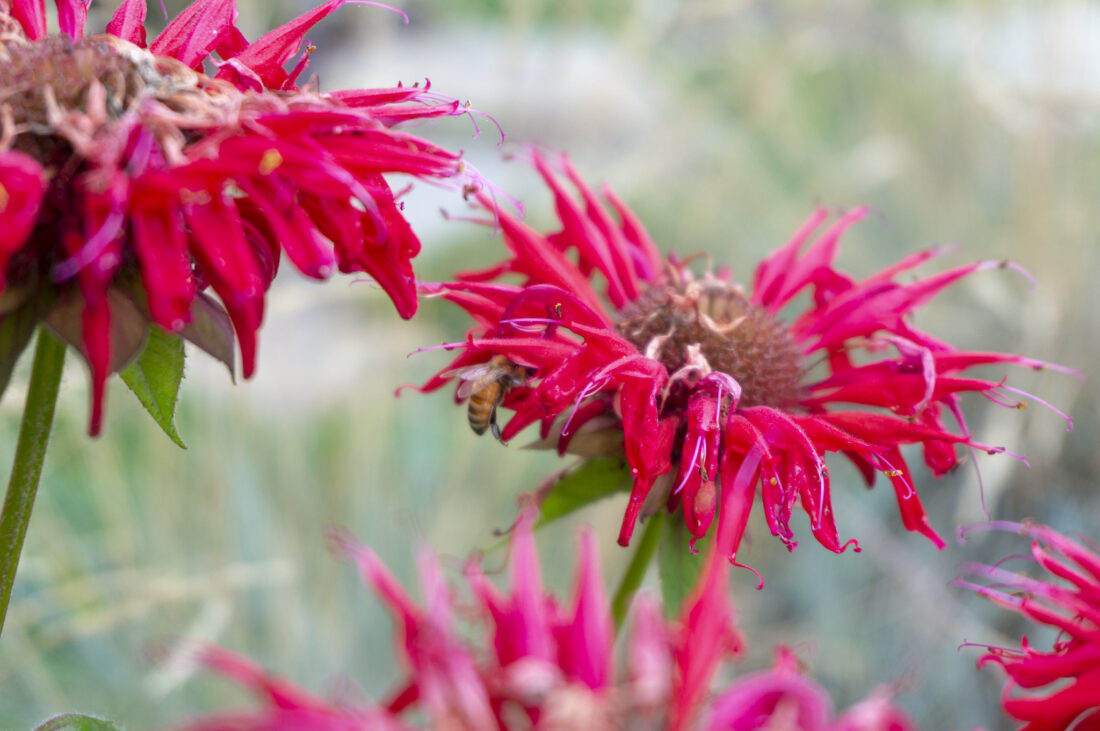
It pulls pollinators into the garden with almost theatrical reliability.
It arrives when the garden needs momentum — a midseason handoff between spring exuberance and summer weight.
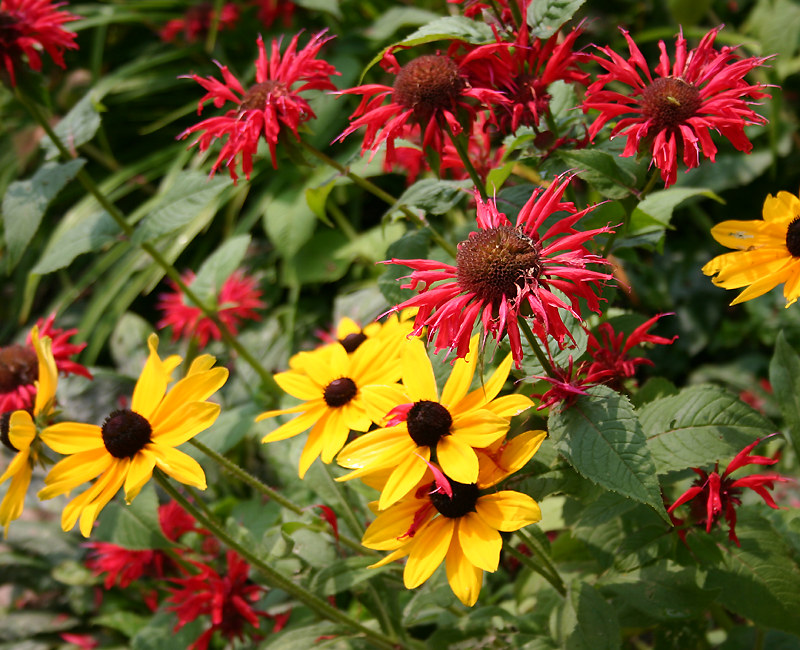
Planted in groups, it creates rhythm and movement — especially when paired with echinacea, rudbeckia, grasses, or, in my case, lavender. It’s particularly effective in rain gardens and naturalistic plantings where vigor is an asset, not a liability.
That said, it is not shy. Bee balm spreads by rhizomes and will happily claim territory if given the chance. This isn’t a flaw — it’s a characteristic. Like many powerful plants, it simply requires clarity about where it belongs.
Like many moisture-loving natives, it asks for decent air circulation — a small tradeoff for the vitality it brings.
Bee Balm – Why It Endures
Some plants earn their place because they behave. Others because they perform. And then there are plants like red bee balm — plants that carry story, ecology, and urgency in equal measure.
They remind us that gardens aren’t just collections of pretty things. They are expressions of values. They reflect what we choose to nurture, preserve, and pass along.
Red makes people nervous in gardens. That discomfort is precisely why it’s powerful. Plant Monarda didyma, and you’re not just adding color. You’re inviting pollinators, honoring history, and making space for a plant that refuses to be quiet.
A plant with a past — and a future.


