
Defending social media against impersonation

Brand impersonation doesn’t stop at the inbox. While organizations have made significant progress securing their email domains with DMARC, attackers are exploiting an adjacent, less-defended surface: social media.
Fraudulent profiles on platforms like Facebook, Instagram, LinkedIn, TikTok, YouTube, and X now mimic company pages, impersonate executives, and redirect users to phishing infrastructure. AI tools have made it faster and cheaper than ever to create convincing fakes at scale, and the barrier to entry keeps dropping.
For security teams, this is a visibility gap. Traditional domain monitoring doesn’t extend to social platforms, leaving organizations exposed in the very spaces where customers and partners engage with their brand daily.
Why social media is the next impersonation frontier
Unlike domain-based attacks, which require registering infrastructure and hosting phishing pages, social media impersonation is operationally simple. An attacker creates a profile using a company’s name, logo, and branding. They copy executive headshots and bios. Within minutes, a convincing fake account exists on a major platform with no technical footprint for traditional tools to detect.
These accounts misdirect customers toward phishing sites and scams, impersonate executives to spread misinformation or solicit sensitive data, and target supply chain partners through profiles that appear to represent legitimate contacts. The attack surface is vast, unstructured, and sits outside the scope of most existing security tooling.
When email and domain defenses tighten, impersonation shifts to channels where protection is thinner. Social media offers low friction, broad reach, and limited accountability. A single fraudulent account can interact with thousands of users before it’s flagged, let alone removed. Industries with high-value customer relationships, from financial services to retail and professional services, are seeing a steady increase in social media-based brand abuse.
Extending Cisco’s protection from email to social media
Cisco first partnered with Red Sift to bring DMARC protection to its customers through Red Sift OnDMARC. That partnership expanded with Red Sift Brand Trust for lookalike domain detection and takedown, creating a full-spectrum defense.
Now, Brand Trust’s newest add-on, Social Media Monitoring, is now available through Cisco. This gives Cisco customers the ability to detect and respond to fraudulent social media profiles that impersonate their company or executives.
Cisco customers already rely on anti-phishing defenses to protect their inboxes. Social Media Monitoring extends that protection to a channel where phishing is harder to catch and increasingly common. Fake company profiles lure customers toward phishing sites, scams, or malware. Fake executive profiles exploit leadership trust to solicit sensitive information or spread misinformation. These are phishing attacks by another name, just delivered through social platforms instead of email, and they sit outside the reach of traditional domain-focused or mail-based defenses.
Why Brand Trust’s approach works
Most organizations that attempt social media monitoring do it manually: running periodic searches, relying on customer reports, or waiting for platform-level detection that often comes too late. Brand Trust takes a different approach by scanning millions of profiles continuously and applying the same AI-powered detection used for lookalike domains to the social media surface.
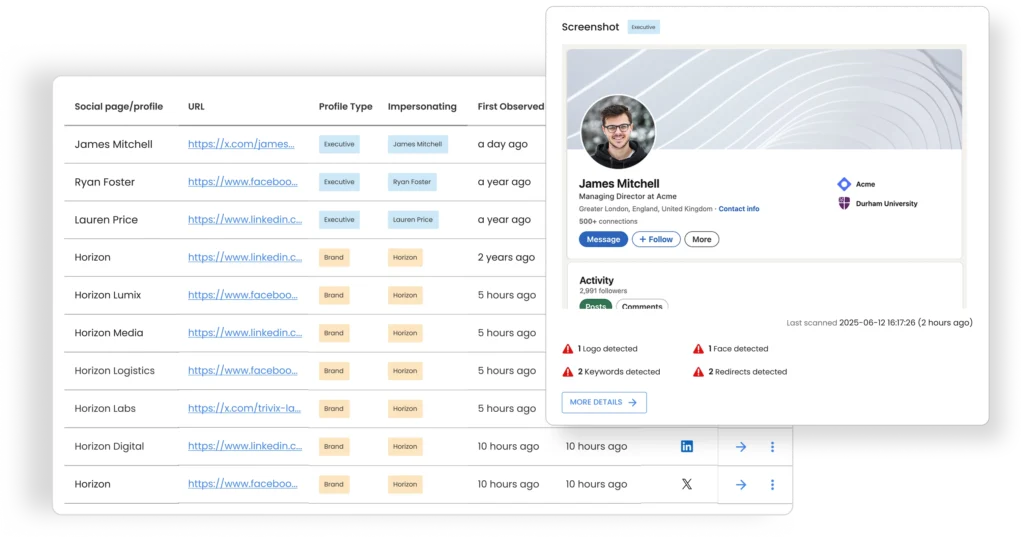
Rather than drowning teams in raw alerts, it surfaces only the accounts worth investigating, with enough context to make a fast classification decision. Takedown workflows are built into the same interface already used for domain protection, so teams can act on social impersonation threats without switching tools or adding operational complexity. The result is a consistent detection-to-response process across domains and social platforms, managed from a single view.
With OnDMARC for email authentication, Brand Trust for lookalike domain detection and now Social Media Monitoring for platform-based impersonation, Cisco customers have access to layered brand protection that covers the full scope of how their brand appears online and protects against its abuse. The best part? Red Sift’s product portfolio integrates within existing customer ecosystems, complementing Cisco’s Secure Email Threat Defense, allowing security teams to operate with complete confidence and full visibility.
For more information on domain protection and Social Media Monitoring, please visit Red Sift’s Cisco partner page.
We’d love to hear what you think! Ask a question and stay connected with Cisco Security on social media.
Cisco Security Social Media