
I Don’t Want to Fight about Sharpening

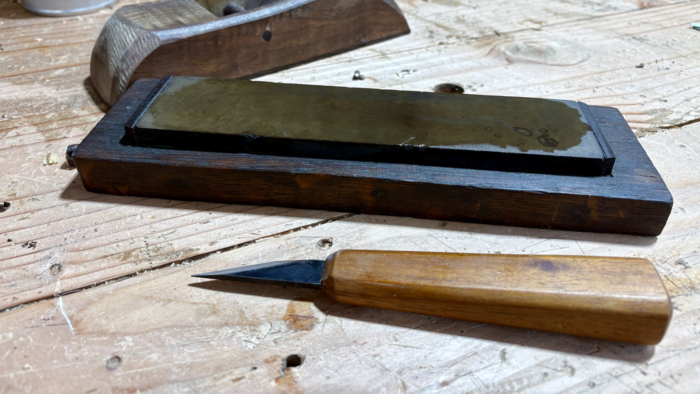
There is probably no topic in woodworking more divisive than sharpening. I bet that more time is spent arguing about it than actually doing it! I won’t pretend to be an expert, but I do have a lot of practice, and my tools are sharp. For today’s post, I thought I would share my system and some tips for effective sharpening. These fit my shop, my style of work, my values, and my trade. This math might not work for you, but it does for me.
I use oil stones. I used to use Shapton water stones, but my lack of a sink in the shop and the need to frequently flatten them was not ideal for me. In 5 years, I wore through my main stone almost entirely to the glass. I also used a honing guide to set my angle, which was a bit of a hassle and a crutch, if I am being honest.
I decided to switch to oil stones for a few reasons:
- I am old-fashioned and romantic.
- I don’t have a sink in the shop.
- I inherited a few and wanted to try them out.
To get started, I listened to some advice from the folks at Mortise & Tenon Magazine and a YouTuber named Richard Maguire. (Check out his method here, if you have an extra 45 minutes.) I would only need my bench grinder, a coarse stone, a fine stone, and a strop. No guides, no jigs, and less gear than most people use in late-stage capitalism. I remembered that the owner of a British tool shop that I like uses the same method, so I wrote to him and asked him to pick out what I needed. I just looked back at my email and found the receipt. I actually bought three stones from him: a fine India stone (which is actually coarse for my work), a fine Arkansas stone, and a piece of Welsh slate that is really fine. The first is a man-made product, the last two are natural rocks lapped flat.
This was about $175 at the time, but will likely last me for many years, so it seemed like a bargain. I got to work sharpening freehand, without a jig, and quickly got good enough at it. I have found lots of old tools that cut very well, where the bevel was rounded and not very precise. This is the type of bevel I get with freehand sharpening, and I find it to be very strong and durable compared to my previous method, which involved producing a hollow grind and a “micro bevel” that usually chipped or wore away quickly.
I actually have three sharpening stations now. The first is the back/metal working room: a grinder, three stones, a strong light, and some WD-40 for lubrication. In the drawer below are some small, curved stones, useful for uncommon tools.
Here is the small tray next to the main woodworking bench, with two small Arkansas stones and a strop. It mainly gets used for touchups.

Lastly, here is what I keep by my bench in the front setup room/studio/office: an Arkansas stone that came from my grandfather’s barn and a strop.
Here are my tips:
- Sharpen often. It takes less than a minute to refresh an edge, saving you time and improving the quality of your work. You can’t be good at freehand sharpening without practice.
- Own fewer tools. Fewer tools mean less maintenance and more time working. Keeping 12 chisels sharp is a significant drain compared to keeping 6 sharp.
- Stick with one sharpening method and keep practicing. Practice is better than buying another jig, aid or gadget that promises better results.
- Avoid the desire for mirror finishes and aerospace-level sharpening. We are sharpening a tool, not going to the moon.
- Read Sharpen This by Christopher Schwarz.
After all that, there is only one thing left to do: sharpen something and get back to work.
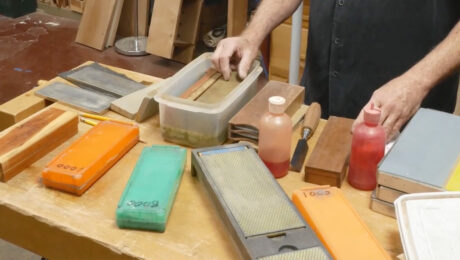
Sharpening systems explained
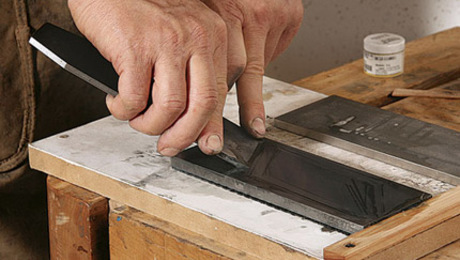
Brian Boggs Demonstrates Freehand Blade Sharpening

Hand-Plane Ergonomics
Fine Woodworking Recommended Products

Honing Compound
This honing compound is great for loading into a buffing wheel and polishing an assortment of metals.
Norton Water Stones
This kit includes everything you need to sharpen all of your blades, with water stones in four grits and a separate stone to keep them flat.

Wen Diamond Grinding Wheel
Diamond grinding wheel is perfect for flattening grinding wheels before honing chisels and plane blades
Sign up for eletters today and get the latest techniques and how-to from Fine Woodworking, plus special offers.