
Developing an Easier Font for Chip Carving, Part 2

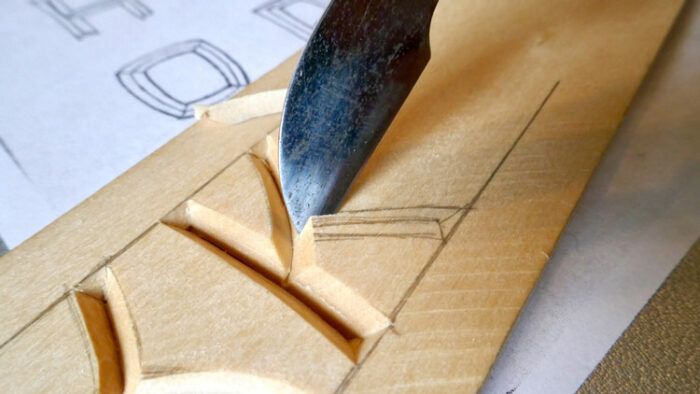
Last time, I discussed the chip-carving classes I teach to my sixth-grade students and my growing fondness for letter carving—particularly how effective it can be with nothing more than a chip-carving knife.
Through experimentation, I discovered one guiding principle that makes the process much easier: Avoid rounded corners and tight arches whenever possible. Instead, rely on straight lines and broad, moderate curves that meet at corners. This approach produces letters that feel strong and clear, while also echoing the prehistoric, pillowy-faceted look of polygonal masonry or “cyclopean” stonework.


The beauty of this polygonal aesthetic is its flexibility. Even if you adapt the typefaces I propose—flattening an arch here or curving a straight line there—you will still end up with letters of beauty. In practice, however, some letters present more challenges than others. To address this, I developed a few templates that offer alternative approaches.
Letter B
One option shows the central bar not intersecting the left upright groove. In another, the letter is derived from the form of a P, with an additional element descending from the lower bowl of the P back to its base.


Letter J
The first version begins with a horizontal top bar, then drops into a slender arc descending from the right corner. In the second, the top bar is angled slightly, the main vertical is long, and the foot ends in a curved arc.


Letter K
One version resembles an H with a broken right upright; the other resembles a Y with an added leg.


Letter R
Like the B, it can be created from a P form, either with an added right-angle leg or with a modified bowl.

Letter S
The letter S is built from five successive arcs. If the middle arc is concave, the letter begins to resemble the digit “5,” which is an interesting variation to note.


As these examples show—and as you’ll see in the letter template sheet I provide—this polygonal, Steiner-inspired typeface is both beautiful and practical. I call this chip-carving alphabet Chiselgeist. The letters are straightforward to carve, visually striking, and an excellent addition to chip-carving projects. For students, Chiselgeist makes lettering in wood (using a chip-carving knife) more approachable and rewarding than traditional methods.
Give it a try. You may be surprised at how elegant and satisfying the results can be.
Sign up for eletters today and get the latest techniques and how-to from Fine Woodworking, plus special offers.


