
Remarkable Mentors: Wendy Maruyama and Tom Loeser

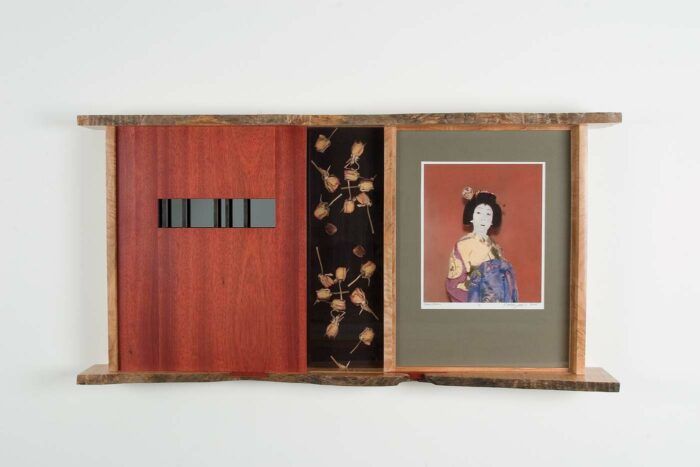
 When Wendy Maruyama arrived at Boston University’s Program in Artisanry (PIA) in 1976, she was one of its first female students. She stood out in other ways as well. In a class full of white kids from the East Coast, she was a third-generation Japanese-American from California. Her teachers, Jere Osgood and Alphonse Mattia, both former students of Tage Frid, were virtuosos at the workbench; her earlier training at San Diego State University (SDSU), an art-school program, hadn’t progressed beyond dowels and stack lamination.
And Maruyama has a hearing impediment, which made it difficult to catch everything her teachers said—especially Osgood, who spoke in a soft mumble. Yet she made her way through PIA and went on to get a master’s degree from Rochester Institute of Technology, Frid’s old program. Maruyama’s impulse was to treat furniture as a form of sculpture, but RIT “was extremely conservative,” she said. “You didn’t see a lot of innovation coming out of there.”
Often unhappy but never undaunted, Maruyama persisted—and blossomed. “For me, furniture was always intended to be a vehicle of creative expression and experimentation.” She went on to lead the furniture program at SDSU herself from 1989 to 2015, and it redressed many of the issues she had struggled against.
 |
 |
In a field that was often exclusively male, it welcomed women. In place of brown furniture in traditional forms, it welcomed color, mixed media, and sculptural expressiveness. And it challenged students to build furniture with a message, a personal narrative. It has had a deep impact on the field, producing a long list of impressive makers and teachers who have helped bend furniture in Maruyama’s direction.
 Color theory. Like Maruyama, Tom Loeser attended BU’s Program in Artisanry, and he too led a landmark graduate-level furniture-making program (his at the University of Wisconsin, Madison) that encouraged students to take furniture
in unexpected directions. His own inventive, playful work is distinguished by vibrant colors and emphatic textures.
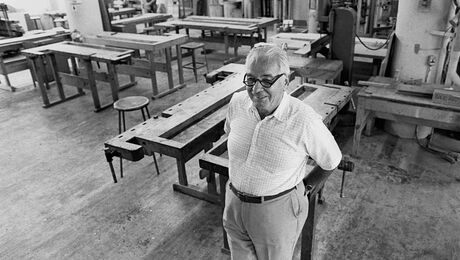
Benchmarks: Wendy Maruyama — Finding her rockstars in FW, before becoming a rockstar in FW

The Future of Woodworking: Alison Croney Moses
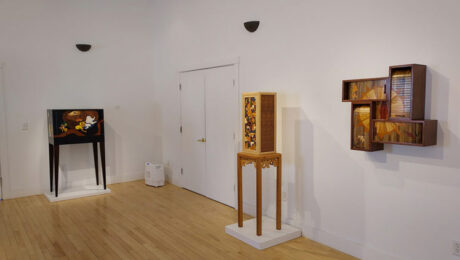
Free Verse: Marquetry Gallery
Fine Woodworking Recommended Products

Blum Drawer Front Adjuster Marking Template
This template acts as a “dowel center” for punching a hole to mark where to drill fro clearance holes.
Sign up for eletters today and get the latest techniques and how-to from Fine Woodworking, plus special offers.
Download FREE PDF
when you enter your email address below.
View PDF


